Launch your own 501(c)(3) nonprofit organization in 2 days
The NONPROFIT Incubator Program is an intensive, hands-on event for entrepreneurs and investors who are ready to roll up their sleeves, file their state and federal paperwork, launch their nonprofit website, and accomplish more in 2 days than most nonprofit founders do in 4-6 months.
The #1 Nonprofit Workshop For Participants Looking To Build & Launch Their 501c3 Nonprofits In Real-Time.
Thrive On All Fronts Through Philanthropy
Advance Business, Legal, Tax, Financial, and Charitable Goals With Nonprofits
Protect Your Assets, Reduce Taxes, and Build A Legacy While Educating, Empowering, and Changing Lives
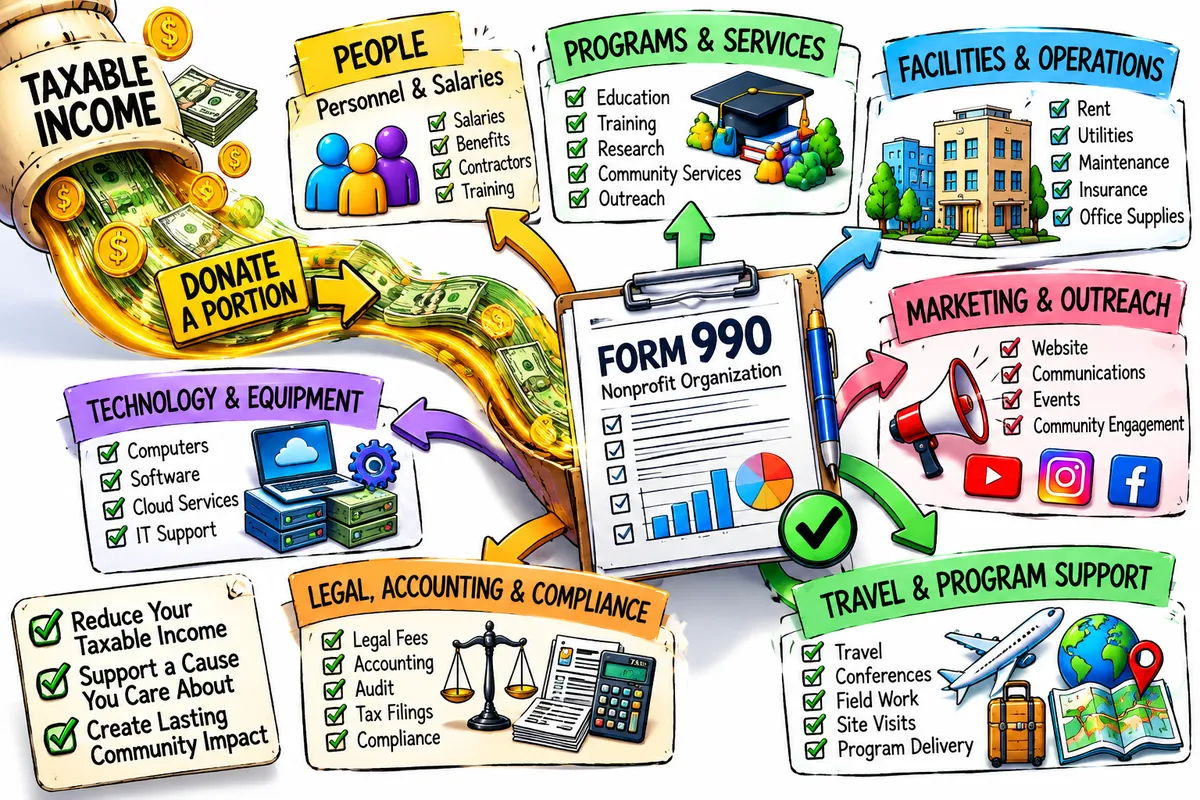
Did you know that individuals can legally reduce their annual tax bill by 30-60% if they donate cash or assets to a 501c3 nonprofit organization, including one they founded? It falls under Internal Revenue Code (IRC) Sections § 170 and § 501(c)(3).
Under Treas. Reg. § 1.501(c)(3)-1, you can capitalize your own nonprofit and fund the operations, growth, and marketing while taking advantage of the allowed tax deduction limits, but the transfer to the nonprofit bank account MUST be completed by 12/31/2026. We are now in Q4, which means you have about 3 months to complete registration, open a bank account, and transfer funds into the nonprofit bank account to unlock this massive tax benefit for 2026.
What if deploying your own 501c3 nonprofit to educate, teach, conduct research, host a podcast, publish articles in a magazine, or host workshops and AI cohorts becomes your biggest tax strategy for this year? The logic is simple - if you are willing to invest a portion of your treasure to benefit humanity, you will receive a tax break for it. These are funds irrevocably set aside to benefit society, not your personal tax-free fund to use as you please.
You and your family members can donate every year, for the rest of your life, if you want to, legally and ethically. This is not a tax loophole or hack - it's a century-old concept that has been embedded in the tax code since the early years to encourage philanthropy. Before diving into the benefits and advantages offered by deploying a 501c3 nonprofit, it's important to understand the different types of nonprofit structures and how they differ. Let's explore those briefly.
501c3 Public Nonprofit (Active Model)
Versus
501c3 Private Foundation (Passive Model)
1. Funding and Capitalization Differences:
Public Nonprofits: Funded by a broad base of donors - including founders, board members, corporations, government agencies, and the general public. To maintain public charity status, the IRS requires at least 33.3% (one-third) of total financial support to come from public sources. This is the ideal vehicle if you plan to supplement your own capital with corporate sponsorships, institutional grants, and public donations.
Private Foundations: Funded primarily by a single individual, family, or corporation. Operating as a structured "charitable trust fund," foundations focus passively on asset investment and grantmaking rather than active public fundraising. You act as the grantmaker funding external initiatives - meaning you do not apply for corporate, foundation, or government grants.
2. Board Members and Governance:
Public Nonprofits: Public nonprofits require at least 3 board members, with a majority (or at least one key independent seat) comprised of unrelated, independent individuals. The IRS enforces this independent governance requirement to ensure unbiased oversight, prevent conflicts of interest, and guarantee that donated funds serve the public good rather than the personal financial benefit of founders, donors, or family members. Board members cannot be related by blood, marriage, or employment subordination.
Private Foundations: Private foundations offer far greater internal control. Because they are family or single-donor funded, family members, business partners, and related parties CAN serve on the board together and control all strategic decisions. You do not have to give up governance rights to outside independent parties, making it the preferred vehicle for families who want to retain strict control over their charitable trust assets and long-term grantmaking directives.
Please Note: The 501(c)(3) Nonprofit Intensive focuses strictly on launching an active Public Nonprofit - building educational programs, publishing magazines, hosting podcasts, and acquiring grants from various sources.
If you are looking to launch a passive Private Foundation focused purely on investing assets and making grants, then check out our half-day Private Foundation Intensive in the main menu.
Unlock 25+ Unique Layers Of Benefits By Incorporating A 501c3 Public Nonprofit
1. Multi-Layer Tax Optimization
Income Tax Relief: Deduct up to 60% of AGI for cash contributions and 30% for donated assets under IRC § 170.
5-Year Carryforward: Roll over unused deductions beyond annual income limits for up to 5 consecutive tax years.
Capital Gains & Depreciation Mitigation: Donate appreciated stocks, real estate, or business assets to eliminate capital gains taxes and bypass real estate depreciation recapture upon exit.
Estate & Gift Tax Shield: Transfer strategic family assets out of your personal taxable estate to minimize federal estate and state inheritance liabilities.
2. Strategic Growth, Innovation & Unlocked Channels
New Markets & Buyer Audiences: Expand into brand-new demographics, institutional buyers, and client segments that won't engage with standard for-profit pitches.
Experimental R&D & AI Sandbox: Run cutting-edge research, test experimental AI tools, and incubate risky programs under scientific and educational mandates without risking core business operations.
Monetized Programs & Merchandise: Build and sell courses, educational certifications, books, merchandise, and paid memberships to generate earned revenue that stays within the tax-exempt ecosystem.
Sponsorships & Event Funding: Attract corporate sponsors, brand partners, and institutional grantmakers to fund high-impact workshops, summits, and live events.
Expert Media Engine: Interview top industry executives, researchers, authors, and experts to share case studies, expose industry scams, and cover ideas that fall outside your primary business model.
3. Business & Financial Expansion
Non-Dilutive Grant Capital: Secure corporate, foundation, and government grants without diluting equity or giving up ownership.
Program & Earned Revenue: Charge for courses, certifications, publications, and events, keeping untaxed surplus capital within the organization to fuel growth.
Founder & Family Compensation: Legally employ yourself or family members at reasonable salaries to direct programs and operations.
Double Bottom-Line Growth: Turn core intellectual property into public-benefit educational initiatives that advance both profit and social impact.
4. Estate Planning & Asset Preservation
Probate Avoidance: Seamlessly move key family assets and strategic capital into a dedicated non-profit entity outside of probate court.
Generational Legacy Building: Establish an enduring, mission-driven ecosystem managed by family members across generations.
Asset Protection: Insulate donated charitable assets from personal liability, business litigation, or creditor claims.
5. Media Engine, Reputation & Permissible Benefits
High-Authority Publishing Engine: Launch podcasts, digital magazines, and educational hubs that build instant market preeminence and Google EEAT (Experience, Expertise, Authoritativeness, Trustworthiness).
Consumer Protection & Industry Oversight: Expose market scams, audit bad actors, and establish gold-standard ethics in your niche. Build the educational and consumer protection hub that becomes the source of knowledge and truth in a marketplace full of scammers, imposters, and self-acclaimed gurus.
Institutional Alliances: Form strategic co-filing and co-funding alliances with universities, government bodies, private foundations, and Fortune 500 foundations. Avail yourself of opportunities that are exclusive to nonprofits.
Permissible Incidental Benefits (IRS Guidance & Rulings):
Under Treas. Reg. § 1.501(c)(3)-1(d)(1)(ii) and established IRS guidance (e.g., Rev. Rul. 70-186 and Rev. Rul. 67-291), an organization can provide affiliated entities and founders a qualitatively and quantitatively incidental private benefit, provided it is a direct byproduct subordinate to the primary educational mission.
Organic brand exposure, authority building, and indirect lead generation naturally stemming from educational publishing (the "byproduct" of running podcasts, educational hubs, and digital magazines) are recognized as legally permissible incidental benefits - so long as the nonprofit avoids explicit sales pitches, direct commercial promotion, or improper private inurement (as clarified under IRC § 4958 intermediate sanction rules and PLRs evaluating commercial activity boundaries).
6. Fulfilling Impact, Purpose & Personal Satisfaction
Doing Good & Living Purposefully: Channel your expertise and resources into meaningful charitable work that directly uplifts communities and changes lives.
Inner Peace & Stress Reduction: Experience the proven psychological benefits and deep emotional peace that come from active altruism, generosity, and sharing your success.
Building Good Karma & Trust: Cultivate lasting goodwill, positive energy, and widespread community trust by positioning yourself as a selfless leader devoted to public service.
Deep Personal & Family Fulfillment: Leave a legacy of service that inspires your children and family, finding immense personal satisfaction in giving back and empowering others.
Solving The 3 Top Bottlenecks That Prevent People From Leveraging These Benefits & Scaling Their World-Changing Nonprofits
Lessons From Setting Up & Advising 1,000s Of Nonprofits, Unlocking $100 Million In Grants, and Actively Applying For $1 Million In Grant Applications Everyday For Our Existing Nonprofit Clients
BOTTLENECK #1: The Setup Delay: 4–6 Months of Friction
The Problem: Over 50% of nonprofits never launch because founders lose momentum waiting 4 to 6 months to connect legal, tax, state, website, and tech requirements.
The Intensive Fix: You execute 95% of your setup in real time so you go live in just 48 hours.
The Result: Bypass months of back-and-forth delay and walk out with a grant-ready nonprofit, ready to focus on marketing, partnerships, podcasts, and audience growth.
BOTTLENECK #2: The "Waiting For Grants" Trap: Catch-22 Execution
The Problem: Grants are a lottery - not a primary launch plan. Grantmakers act like investors and typically expect to see active, proven community impact before releasing funds.
The Intensive Fix: We teach you how to leverage IRC § 170 tax deductions to self-fund initial launch operations alongside scalable, revenue-generating programs.
The Result: Eliminate cash-flow freezes, fund your early programs immediately using tax dollars, and build the real-world traction grantmakers want to see.
BOTTLENECK #3: The Invisible Nonprofit: Static Sites With No Eyeballs
The Problem: Most new nonprofits run static websites with zero traffic, no marketing strategy, and no income streams - leaving them invisible to donors, customers, and sponsors.
The Intensive Fix: We deploy an evergreen publication and distribution hub - using podcasts, digital magazines, and search strategies - to generate consistent traffic, stay top-of-mind, and generate cash flow to fuel your day-to-day activities.
The Result: Treat your nonprofit like a business, not a hobby. Build sustainable programs that attract and convert customers, donors, vendors, peers, and grantmakers. Think like an investor - would you fund a brand new project with zero activity and numbers, or one that's actively educating, empowering, and uplifting people, where the founding members.
Solving These 3 Bottlenecks During The Live & Interactive 2-Day Workshop
Having filed thousands of nonprofits - and dissolved hundreds that stalled out - we designed this 2-day intensive to eliminate the exact bottlenecks that derail founders, kill momentum, or lead to status revocation. Walk out with 95% of your launch completed and your foundation fully built - leaving only a few minor tweaks before you’re officially open for business.
Note: You do not need to wait for your official IRS Determination Letter to launch operations. While grantmakers will want to see final IRS approval before releasing funds, you are legally permitted to launch your media engine immediately - hosting podcasts, publishing articles, running workshops, and enrolling community members from day one.
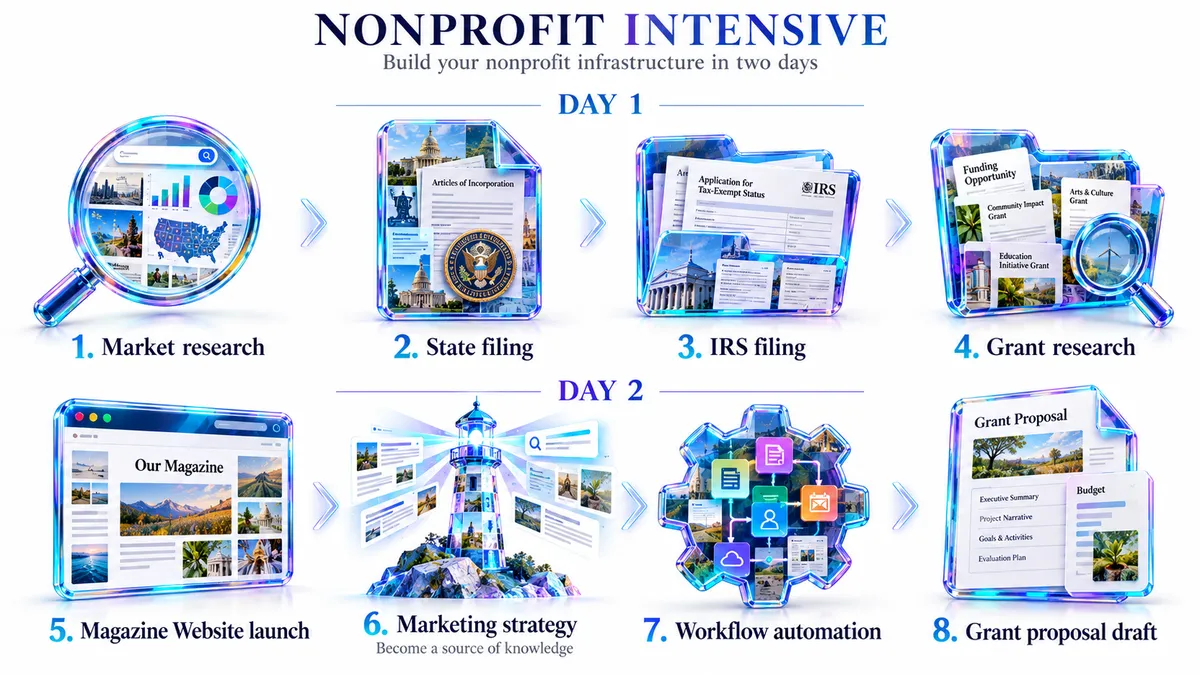
THE 501c3 NONPROFIT INTENSIVE WORKSHOP FORMAT
Day 1: INTERNAL STRUCTURE
Market Research + State Filing + IRS Filing + Grant Programs
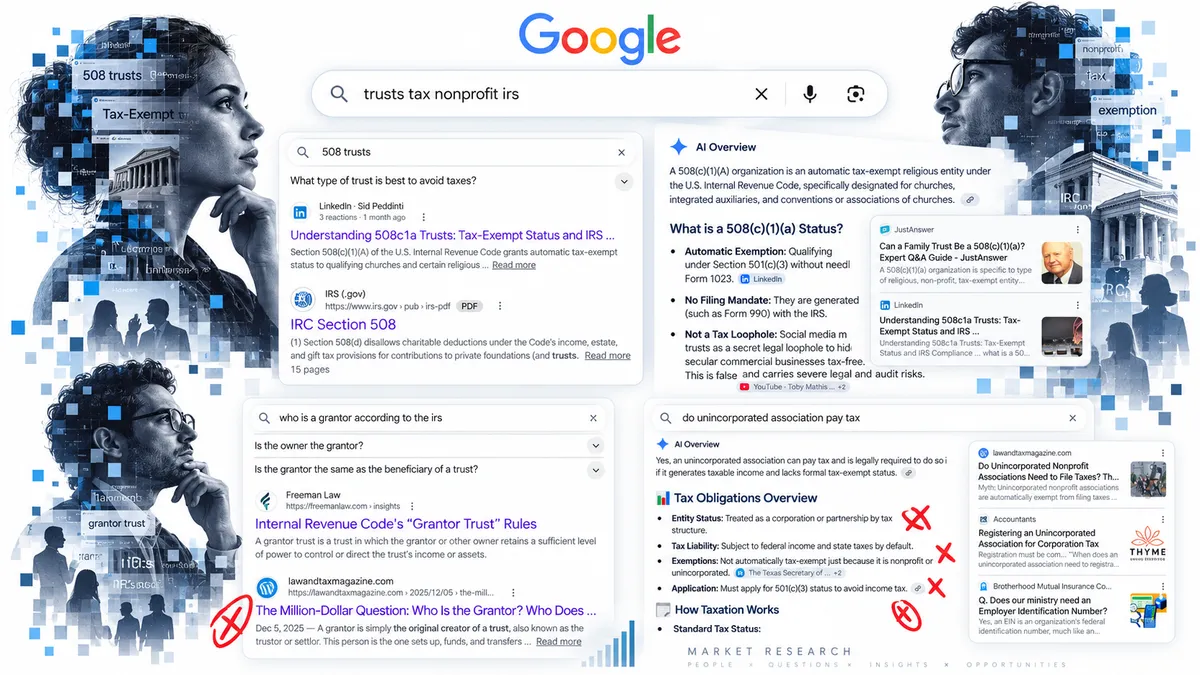
Session 1: Market Research & GTM Strategy
In this session, you will conduct hands-on market research to identify high-value content gaps, analyze competitor positioning, and build your core strategic roadmap. You’ll focus on:
Identifying Market & Industry Gaps: Pinpoint critical service and educational gaps that your nonprofit is uniquely positioned to bridge.
Analyzing Competitor & Keyword Landscapes: Map out the dominant topics, search queries, and industry players currently controlling the narrative.
Uncovering Industry Scams & Traps: Highlight widespread consumer traps, bad practices, and misinformation to establish your organization as a trusted watchdog.
Structuring an Index-Worthy Roadmap: Build a content and mission blueprint tailored to earn trust and index authority across Google and search engines.
Session 2: State Filing: Articles Of Incorporation
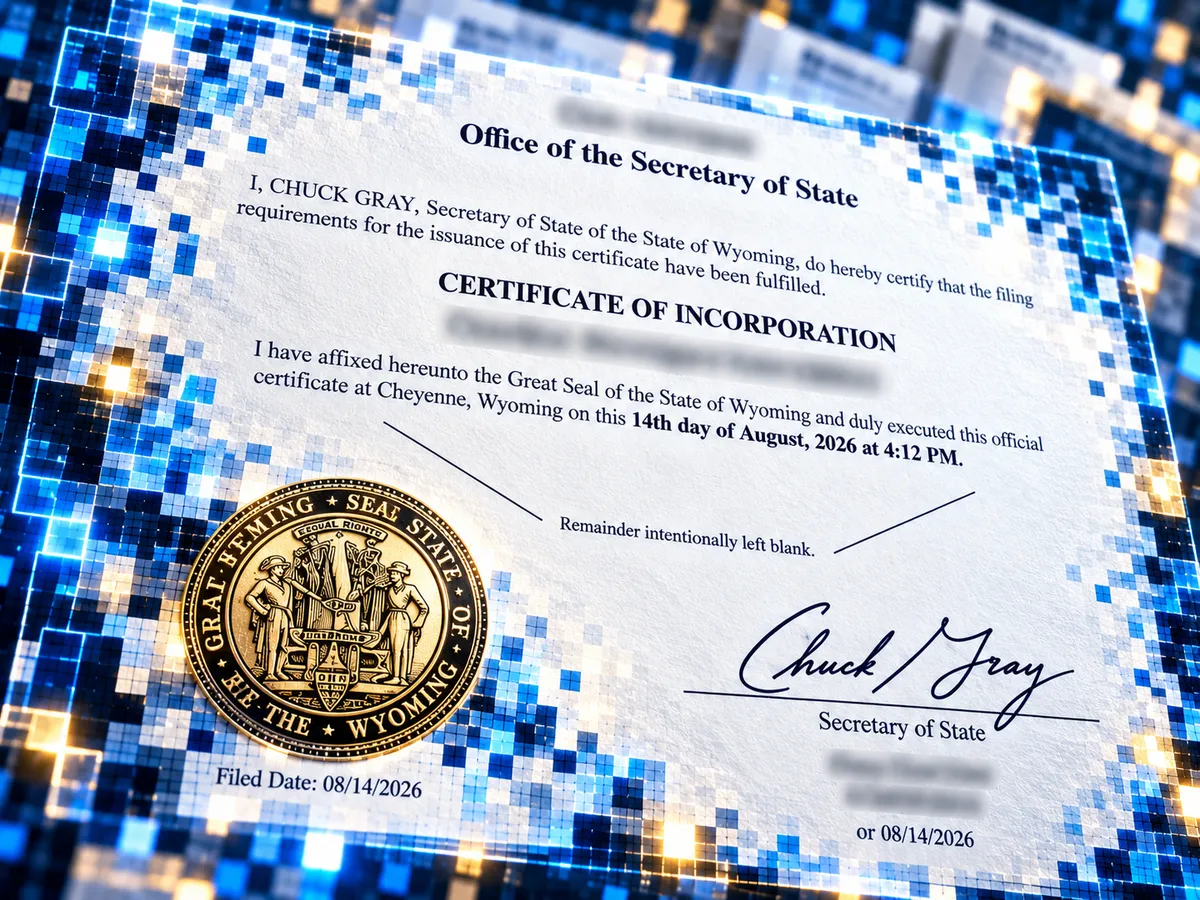
In this session, you will select the ideal legal jurisdiction, register your nonprofit corporation with the Secretary of State, and file your Articles of Incorporation. You’ll focus on:
Selecting Optimal Filing Jurisdictions: Evaluate state-specific corporate statutes to choose the most founder-friendly and cost-effective jurisdiction.
Securing Organizational Naming Rights: Conduct thorough state entity searches to select and reserve an available, compliant nonprofit name.
Appointing Registered Agent Services: Set up professional registered agent coverage to handle official state communications and legal notices.
Executing Compliant Governance Filings: Draft and file legal Articles of Incorporation using mandatory IRS tax-exempt language to prevent state rejections.
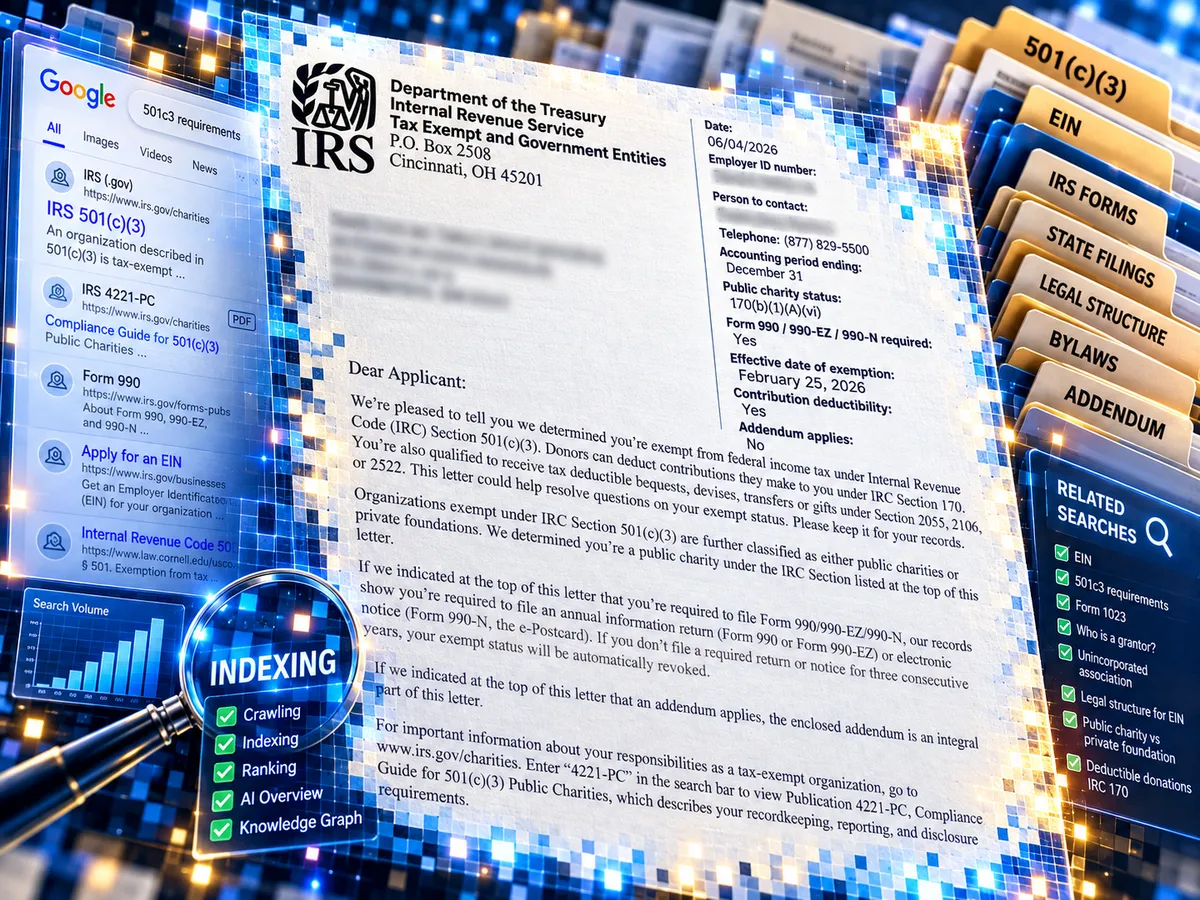
Session 3: Filing The EIN & IRS 1023 Application
The third step is to acquire your Employer Identification Number (EIN) and file the 1023 application with the IRS to gain recognition as a tax-exempt 501(c)(3) nonprofit corporation.
We help walk through the EIN and 1023 applications with caution and care to ensure you avoid mistakes that lead to fines, sanctions, revocation of status, or even taxes (UBIT).
Prepare bylaws, internal documents, and conflict of interest policies
Register and file your 1023 application to seek recognition as a tax-exempt 501 entity
Leverage our battle-tested templates, language, and filing guidance to avoid hidden mistakes that don't surface for years
Session 4: Develop A List of Grant Programs ($10+M)
In the fourth session, you'll get to work on developing a list of around $10 million in grant programs that your organization can apply to. In this session, you'll work on:
Conduct detailed research and develop a list of grants that align with your mission
Develop a user-friendly list where you can track data, applications, and requirements
Turning raw data into AI-powered applications that can be accessed by your team
Developing a list of initiatives that attract the most funding so you can align with them
Identifying 3-5 grant-aligned programs, initiatives, and activities that you can offer
Day 2: EXTERNAL STRUCTURE
Website Architecture + GTM Strategy + Workflow Automation + Sample Grant Application Draft
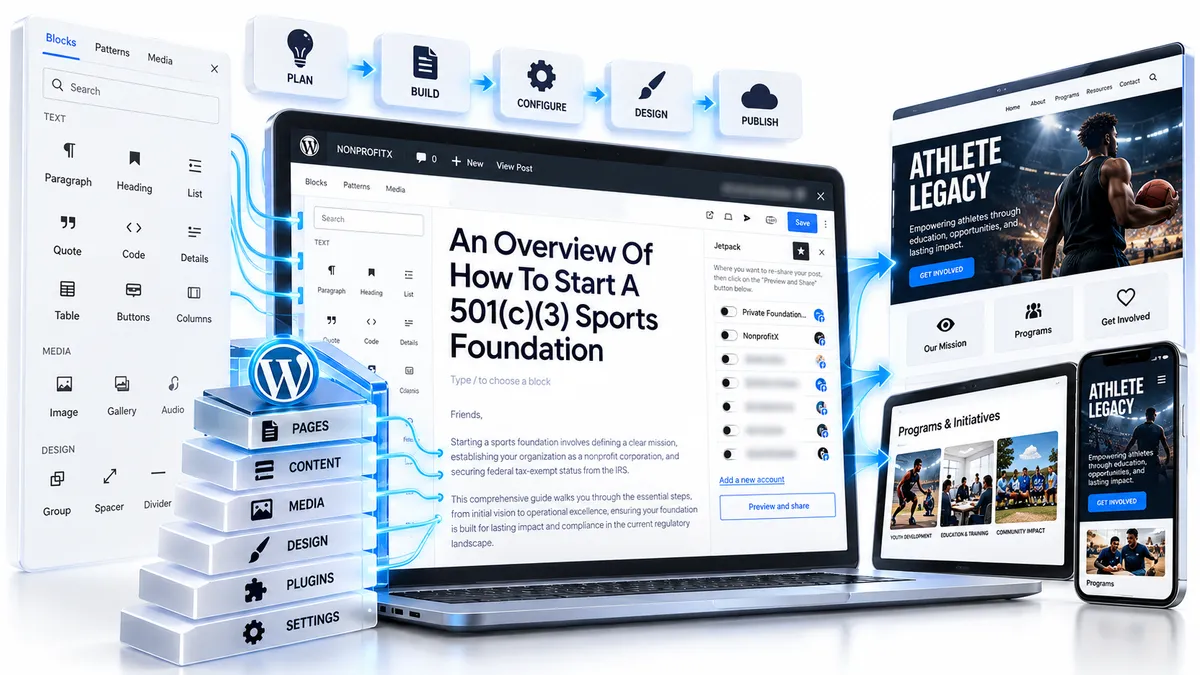
Session 5: Build The Website And Connect The Domain
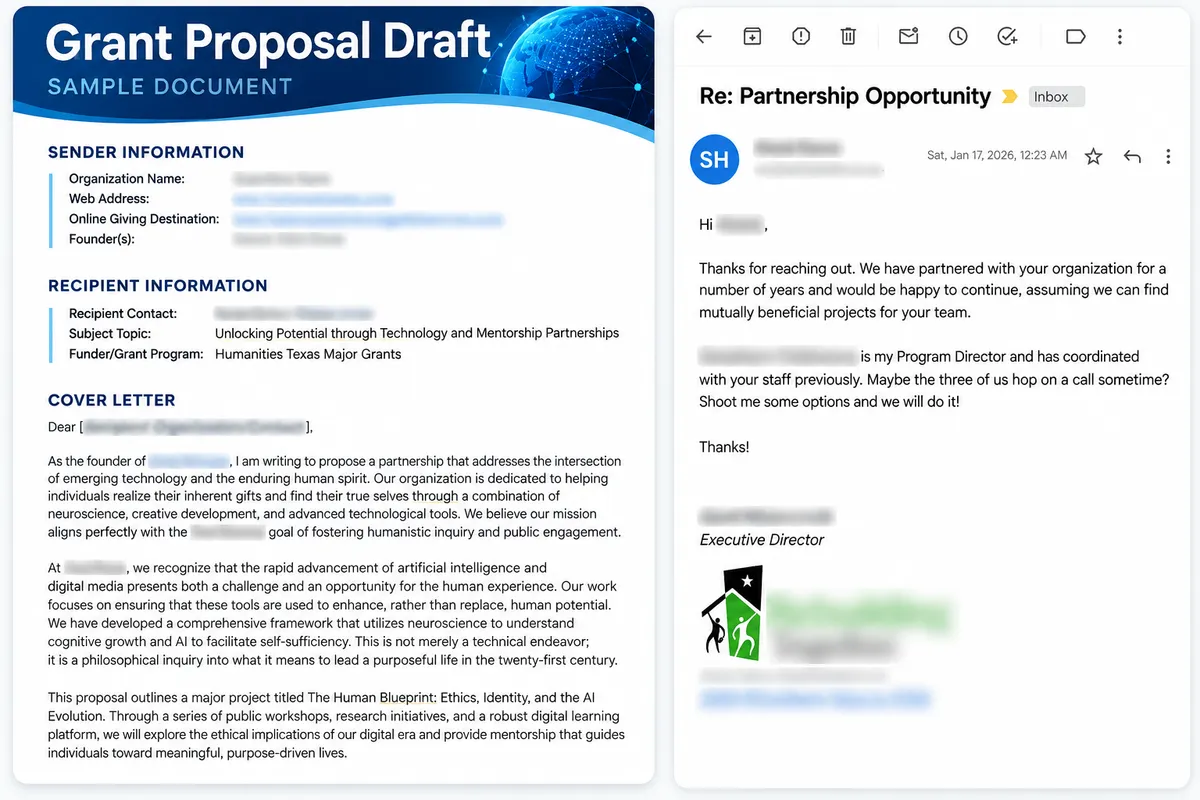
Your nonprofit needs a robust website with rich and evergreen content to attract the right audiences, partners, sponsors, customers, and funders. In our experience, the strategic choice of building a podcast, a magazine, or an educational platform with courses, workshops, events, webinars, apps, or incubator programs are perfectly positioned to hit all the birds with one stone:
Boosts exposure, awareness, and goodwill by developing the ultimate knowledge hub
Elevates trust and authority by leading the marketplace with a publication or podcast
Builds long-term website authority and trust that Google and AI platforms look for
Unlocks new buyers, audiences, markets, partnerships, and opportunities without risk
Allows you to leverage the First Amendment Freedom Of The Press through your magazine
Session 6: Developing Your Market Penetration Strategy
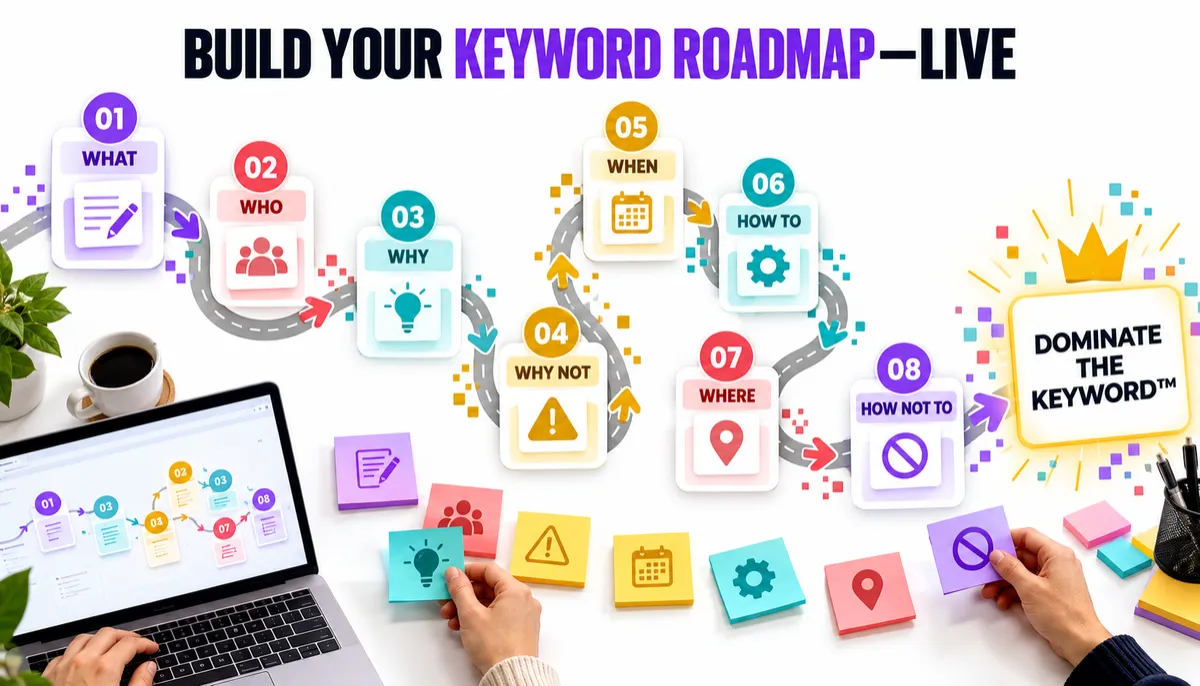
In this session, you will map out the core content categories, authority headlines, and strategic topics driving your podcast, digital magazine, and educational platform. You’ll focus on:
Define Core Content Pillars: Establish high-authority publishing categories that position your nonprofit as an unbiased industry watchdog.
Target High-Intent Search Topics: Identify low-competition, high-value search queries that prospective donors and partners are actively researching.
Build Index-Worthy Assets: Publish educational articles, podcast episodes, and guides structured for top search rankings and AI engine citations.
Extract Proprietary IP & Insights: Turn your real-world case studies, industry warnings, and expertise into permanent digital assets that generate organic leads.
Session 7: Connecting Your Website To Social Distribution
In this session, you’ll connect your central publishing hub to major social media platforms to automatically syndicate and distribute your content at scale. You’ll focus on:
Automate Cross-Platform Syndication: Connect your website to LinkedIn, Facebook, Instagram, YouTube, and TikTok to auto-publish every update seamlessly.
Structure Multi-Format Content: Automatically turn long-form articles and podcasts into platform-optimized video clips, text posts, and graphics.
Build a 365-Day Engine: Queue and schedule evergreen educational content up to a year in advance for continuous marketplace presence.
Maximize Organic Reach: Maintain consistent touchpoints across all channels to re-engage donors, partners, and grant committees on autopilot.
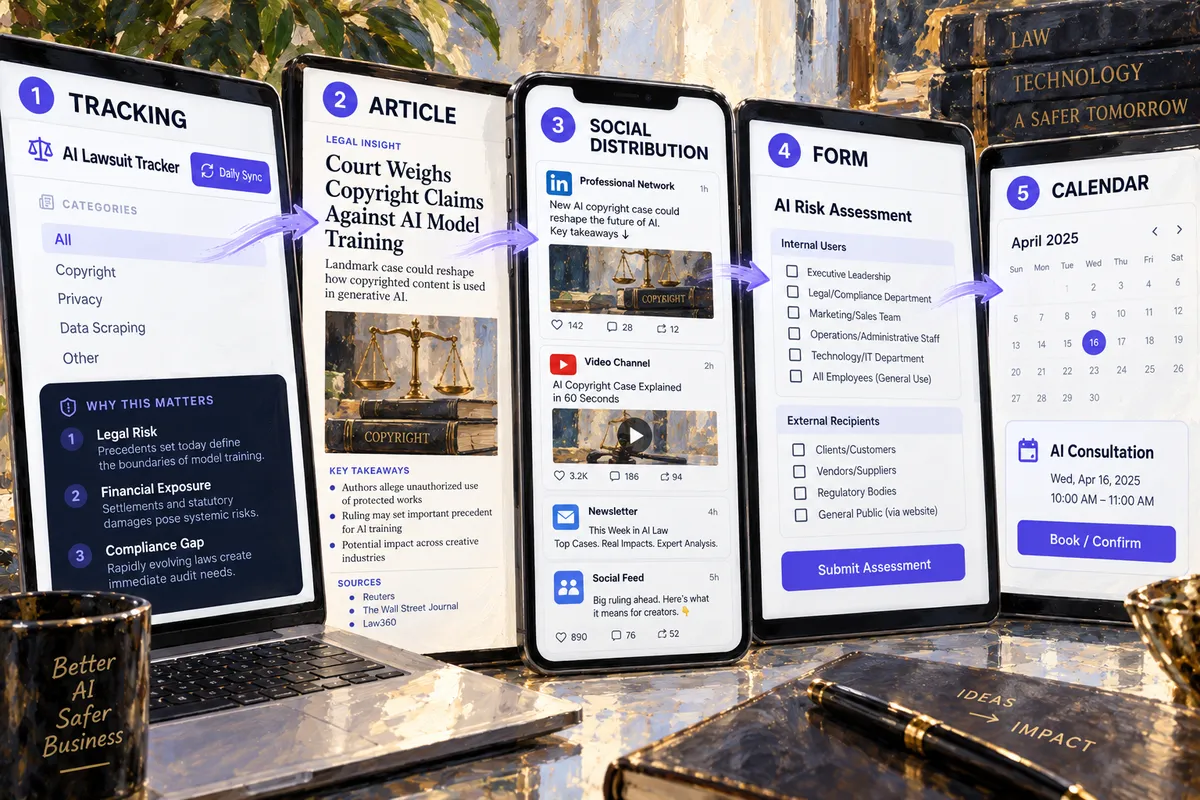
Session 8: Sample Grant Proposal That Aligns
In this session, you will draft a custom grant proposal and build a matching program budget that aligns seamlessly with your website and IRS filings. You’ll focus on:
Crafting a Winning Grant Letter Draft: Write a compelling proposal letter that weaves your mission, narrative, and impact story into a high-converting template.
Aligning Narratives Across All Filings: Ensure your grant storytelling perfectly mirrors your website messaging and IRS Form 1023 disclosures.
Building a Funding-Ready Program Budget: Develop a clear, line-item operational budget tailored to meet corporate, foundation, and government grant criteria.
Scaling Our Mission And Impact By 10x
By Doing The Craziest Thing We Have Ever Done - Giving Everything Away!
Despite all the AI tools available today, founders are still trapped in the same three bottlenecks - because AI alone cannot file state documents, navigate IRS tax codes, or build true market credibility.
To 10x our mission without drastically bloating overhead or charging high retainers, we realized we had to do something radical: give it all away. We pulled back the curtain on everything we learned across law school, filing thousands of cases, and years of running law, tax, web, technology, and grant firms - putting our entire institutional framework directly in your hands.
What went into building this 2-day, one-of-a-kind, and the only nonprofit and tax attorney-led workshop in the marketplace:
10,000+ business, bankruptcy, estate, trust, tax, IP, and nonprofit cases.
5,000+ business and nonprofit filings with state and federal agencies.
$30+ billion in IP digitization and tech infusion for Fortune 500 clients using AI.
$10+ billion in business and personal assets restructured for business owners and investors.
$100 million in non-dilutive grants secured for our nonprofit clients across 100s of sectors.
500+ Google Ad Grants awarded to our clients - $10,000/month in free Google Ads.
For the first time, we are opening our behind-the-scenes playbook in a hands-on, done-with-you format - giving you direct access to the elite legal, tax, and grant strategies used by leading family offices, at a fraction of the cost.
Most founders launch without ever understanding what their legal, tax, financial, or grant filings actually mean. In this learning-by-doing intensive, you will master the rules, tax codes, and compliance guardrails in real time as you build - ensuring you walk away fully educated, empowered, and equipped to lead a world-changing 501(c)(3) for generations to come.
Handing You The Entire Playbook
It took us nearly two decades across law, tax, consulting, advisory, and 10,000+ cases to master this architecture. Now, we’re handing you the entire playbook in just 2 days.
With Us:
One coordinated & coherent approach
End-to-End Execution: The only live and interactive program that unifies legal, tax, tech, media, and grant strategy into one seamless launch.
Proven Track Record: Built on insights from 10,000+ legal, tax, IP, and estate cases, with $100M+ in grants secured for clients.
Active Grant Engine: Access a team actively submitting $1M+ in grant applications daily to secure non-dilutive funding.
Fractional Advisory Team: On-demand experts handling legal, tax, grant writing, AI automation, publishing, and strategic growth.
Double Bottom-Line Growth: Turn your core IP into high-authority media, driving traffic, leads, and grant acquisition on autopilot.
Evergreen IP Extraction, AI Innovation, and Publication Engine: Dominate important keywords, topics, and traffic sources through your evergreen podcast and magazine with 100s of published pieces.
Family Office Architecture: Integrate IRC § 170 strategies to reduce income, capital gains, estate, and gift taxes while preserving wealth.
WithOUT Us:
Siloed. piecemeal. disorganized. uncoordinated.
Fragmented Legal Filing: Lawyers file your state and IRS forms, then walk away - leaving tech, tax, and grants completely untouched.
Disconnected Web Developers: Offshore VAs or agencies build static sites with zero understanding of IRS compliance or grant positioning.
Isolated Grant Writers: Freelancers write applications in a vacuum without fixing your underlying organizational or media traction.
Siloed Traffic Marketers: Ad or search specialists drive traffic without aligning with IRS mandates, legal boundaries, or grant rules, even getting your grant funding suspended or terminated (happened to us).
No Tax & Estate Integration: CPAs and financial advisors rarely cover these nonprofit strategies, leaving massive tax savings on the table.
No Robust Authority, Trust, Preeminence Strategy: Business coaches and consultants don't cover 501c3 integration strategies - too complex and technical.
Social Media Experts: Online "experts" who build or deploy with zero compliance guardrails leave you exposed to lawsuits, audits, and legal sanctions.
Who Is This Workshop Designed For
This is a 100% hands-on, action-packed, fast-paced workshop which is designed for subject-matter professionals, entrepreneurs, and mission-oriented educators who can work in a fast-paced setting.
who is a good FIT for the 501(c)(3) intensive™
Small & Medium Business Owners
Established founders launching a dedicated nonprofit arm focused on education, research, consumer protection, or charitable outreach.
Authors, Speakers & Professional Firm Owners
Published authors, keynotes, licensed professionals, and subject-matter experts across legal, medical, tax, business, and educational disciplines.
Scientists, Tech & AI Innovators
Founders and researchers advancing public-benefit initiatives, scientific research, or ethical AI development.
who is not a good FIT for the 501(c)(3) intensive™
first-time entrepreneurs
Designed strictly for experienced founders with an established business, active client base (50+ clients), and proven subject-matter expertise.
Tax Avoidance Seekers
We do not work with individuals looking for tax loopholes or legal shortcuts. This intensive is strictly about compliant tax optimization by the book.
SINGLE BOTTOM-LINERS
If your sole goal is using a nonprofit as a lead funnel for your for-profit without delivering genuine public-benefit value, this program is not for you.
Let's Get Cracking
At this point, you fall into one of two categories:
You either recognize the immense value of aligning your business, tax strategy, and legacy with a high-impact nonprofit - or you're still undecided on whether philanthropic work and public education are worth pursuing.
This intensive is strictly built for the first category. We are looking for decisive, mission-driven founders who are ready to build, execute, and scale - not skeptics looking for excuses to delay.
Fill out a short application & schedule an interview to discuss the details
1. Schedule An Interview
Fill out the assessment form and schedule a quick call with our team to discuss the details, conduct basic research, and help you set up the right tools, browser settings, and login access.

2. Attend The Intensive
You'll be invited to attend the 2-day session over Zoom. It's important to ensure all the accounts, browsers, logins, and other details work and are easily accessible so you don't get stuck during the workshop.
3. Go Live.
By the end of the workshop, you'll have completed the state and federal filing, have a basic website framework, have a list of topics that fit within the IRS framework, are index-worthy, can attract clients, and impact people in the marketplace.
4. Advance Your Mission With Diverse Funding Options [donation, grants, programs]
We'll work on coordinating with your accounting team so you can secure the Schedule A - Itemized Deduction for the donation to fund your nonprofit (if you choose to go this route).
Explore the wonderful, amazing, and fulfilling world of nonprofits by applying for the only nonprofit & tax attorney-led program in north america.™

Fill out a short, but detailed, application form
Whether you're a startup or a large corporation, we tailor our trademark protection services to suit your needs, helping you protect your brand effectively.

Schedule your 1:1 confidential consulation & set up call
From patent filings to intellectual property disputes, we provide a full suite of services to safeguard your innovations and ensure legal security.
Frequently Asked Questions
why do i need an attorney to file a nonprofit organization?
You do not need an attorney for most legal services - whether immigration, bankruptcy, estate, tax, personal injury, or even criminal law matters. You don't even need an accountant, financial advisor, insurance agent, investment broker, or doctor either - you could, in theory, handle all those matters yourself - but would you want to?
Nonprofit law is very technical, it is written directly into the tax code - arguably one of the most complex areas of law. Our team consists of highly seasoned tax lawyers who have specialized in the nonprofit or tax-exempt sector, and also possess deep business, estate, bankruptcy, M&A, corporate, IP, and finance experience.
Can you file it yourself - absolutely. But, if you're looking to cut down the learning curve by several years, avoid hidden mistakes that are revealed years later, and mitigate risks from internal or external parties - then, hiring a nonprofit and tax legal team that also covers business, estate, and growth strategies will be a true game-changer for you.
HOW LONG DOES THE IRS APPROVAL TAKE?
IRS approval typically takes 4-6 months, but we're currently experiencing a faster-than-usual approval rate - as little as 30-days. But, this can change without notice.
what happens if we do not get approved?
We work help you navigate the next steps, and even assist in communicating with IRS agents, and help you draft the necessary responses or answers. If needed, we will help you refile the application, even file it on your behalf, and help you secure your approval. We have not encountered rejections in our applications since 2008 and happy to even offer a refund if our applications do not get approved, in some rare cases.
Is there a guarantee that we will secure grants from corporations, foundations, or government agencies?
No. We do not work for these agencies, nor do they work for us. While we can help you file the applications, and even file it for you in our accelerator program, there are no guarantees you will receive any funding. To date, we've access just over $100 million in funding and grants, and believe we can 10x that numbers in the next few years - but there are no guarantees, just like there are no guarantees that even a fully funded business or nonprofit will make it.
Can i accept clients who want to hire me for my for-profit products or services?
Yes, provided you do not directly "pitch" and "sell" in the nonprofit. The IRS allows board members, volunteers, employees, and vendors to receive an incidental benefit that naturally comes from advancing the mission of the organization. In other words, the better
Need a Hand With Your IP Practice?
We’re Here to Help.
From docket management to client communications, we provide specialized virtual support so you can focus on prot4cting ideas and innovations.
Ready to Protect Your Intellectual Property?
Book your consultation today and secure your intellectual property
with the expertise of our experienced legal team.
